 Korouoma Canyon
Korouoma in Summer: The Canyon Without the Ice
Last reviewed September 2026
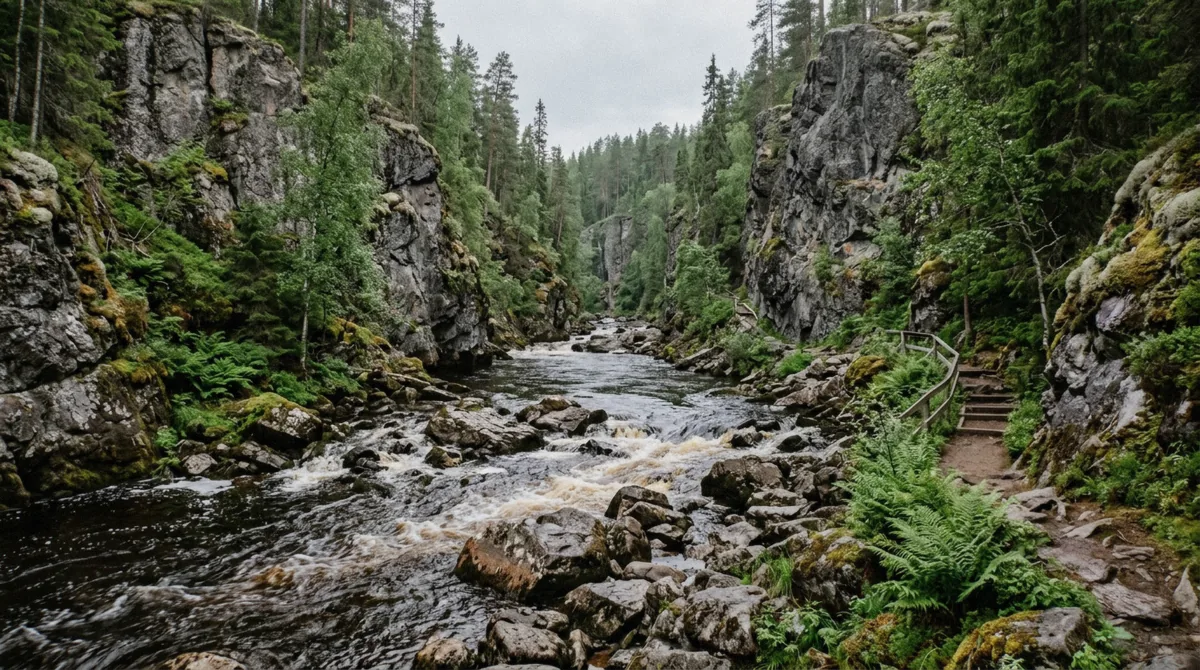
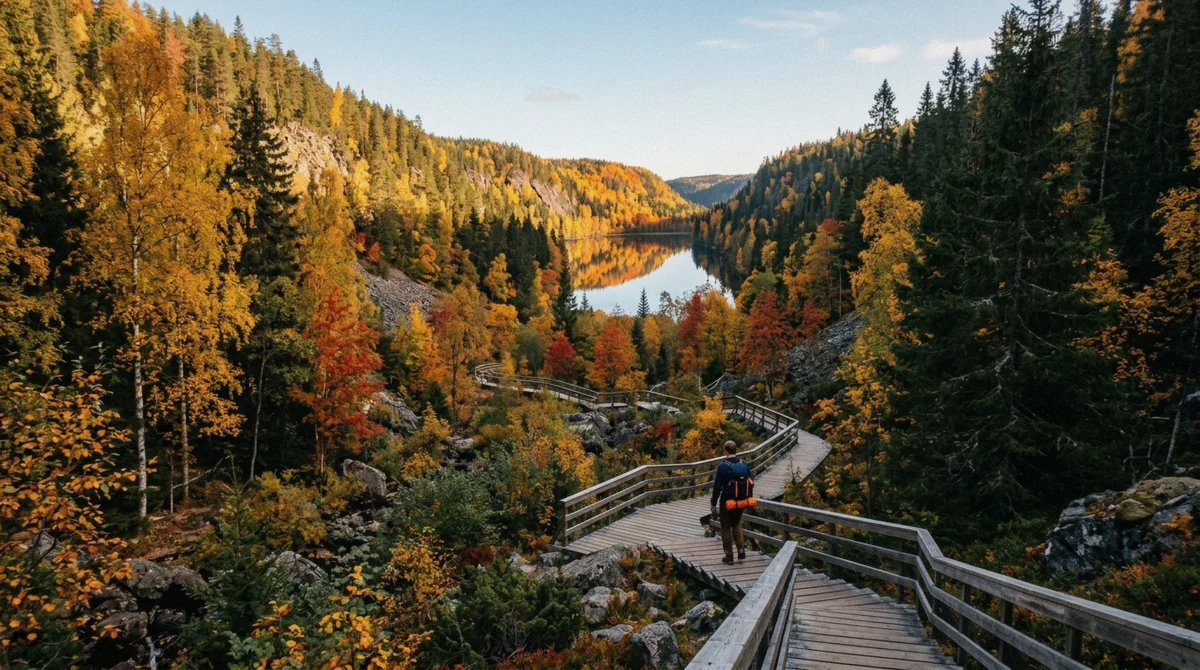
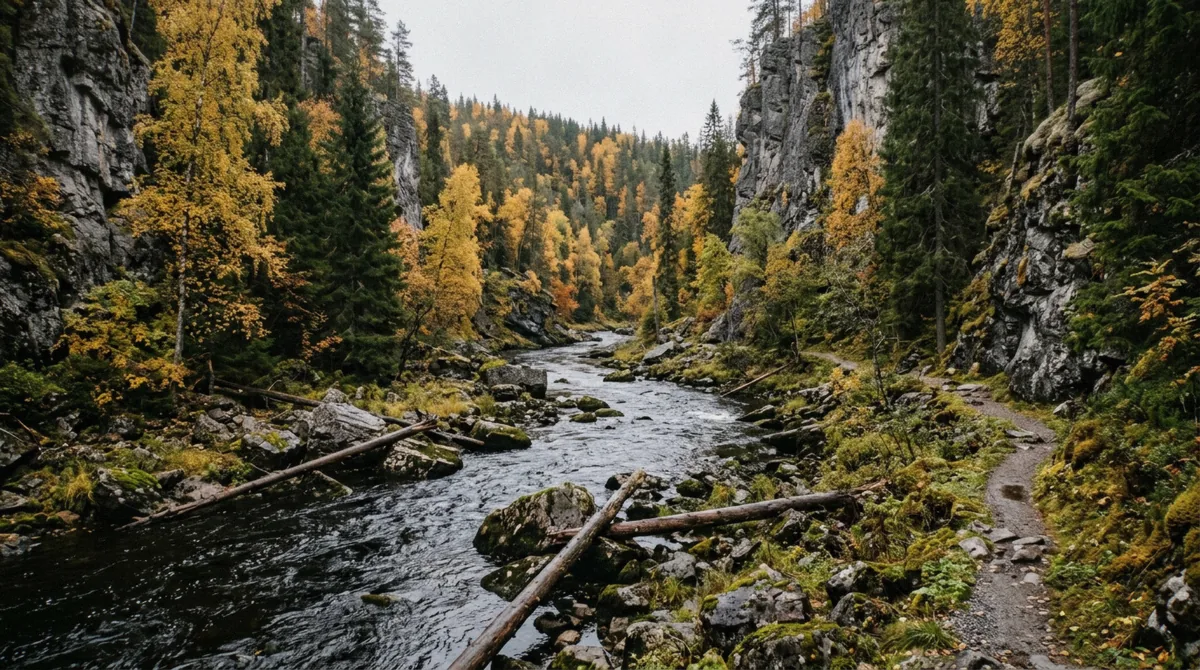
Every tour sold to Korouoma runs in winter, and the canyon is open all year. Korouoma in summer is a different place: from June the Korojoki runs hard through the floor, the herb-rich groves that made this a protected reserve come up thick, and the 17.6-kilometre hiking trail that stays closed all winter opens for the snow-free season. September turns the birch gold for two or three weeks with the mosquitoes finished and the light still long. Nobody sells a tour then, which is exactly why it is worth a rental car.
Quick answer Two trails, one season, and no tour to buy
In summer Korouoma has two trails rather than one. The 4.6 km Koronjaa loop is the same circuit the winter tours walk, with river scenery and lush groves instead of ice. The 17.6 km Korouoma Hiking Trail, graded Hard and quoted at one to two days, can only be used in the snow-free season, and its markings are worn enough that Metsahallitus recommends carrying a map and compass. Neither has an entry fee and no guided departure on this site runs outside winter.
Key takeaways
- The 4.6 km day loop works all year; only the surface changes
- The 17.6 km long trail opens only when the snow has gone
- September ruska: gold birch, no mosquitoes, long light
- Camping is allowed only beside marked rest and campfire sites
- No summer tours here. The winter Korouoma departures are the ones sold
The Two Trails, Once the Snow Has Gone
The day loop, in green
The Koronjaa Trail is the one every winter group walks, and Metsahallitus describes it as the only trail in Finland where you can admire frozen waterfalls in winter and river scenery in summer while always sensing the presence of the cliffs. In summer the descent that terrifies people in April is simply a steep path, the fixed rope is a handrail, and the falls are running water on dark rock.
It follows an old horse road along the canyon floor, with information boards on the logging history, and the same clockwise direction is recommended. Four and a half kilometres, one to two hours of walking, still graded Hard because of the profile rather than the surface.
The long trail, which winter closes
The Korouoma Hiking Trail is a different proposition: 17.6 kilometres, one to two days, graded Hard, running through the cliff landscapes, along the ridges at the end of the valley and past a series of lakes. Metsahallitus is direct about two things. It can only be used during the snow-free season. And the trail markings are worn in places, so bring a compass and a map.
That is the walk people come with a tent for, and it is the reason the reserve has lean-tos and campfire sites spread along it rather than only at the trailhead.
Getting between the two
The day loop starts and ends at the Saukkovaara car park, and the long trail runs through the same reserve on a different line, which means a summer visit can be either a two-hour walk or a two-day one from the same parking space. Most people do the loop, look at the sign for the long trail, and file it away for another year.
There is no shuttle and no through-service, so a linear walk on the long trail means either an out-and-back or two cars. In practice that is the main reason the day loop carries almost all the visitors in every season: it is the walk that fits into a drive from Rovaniemi and back.
June to October, Month by Month
What each month gives you
The summer half of the year at 66 degrees north is short, bright and dramatic in a completely different register from the winter one.
| Month | The canyon | The catch | Worth it for |
|---|---|---|---|
| June | Meltwater peak, everything green and loud | Mosquitoes arrive; the long trail may still be wet | The river at full volume, and light all night |
| July | Warmest, around 20C by day | Mosquitoes at their worst | Swimming lakes and the long trail |
| August | Warm, berries ripening | Fewer insects, first dark nights return | Berry picking and easy walking |
| September | Ruska: gold and red for two or three weeks | Weather turning, short window | The best photography of the whole year |
| October | Bare, wet, the first frosts | Nothing is frozen yet and the colour has gone | Solitude, and the earliest ice in a cold year |
Midnight light and the mosquito question
At this latitude the sun barely sets around midsummer, which makes an evening walk into the canyon one of the better things you can do with a Finnish June. The light at ten in the evening is soft, low and gold, and there is nobody there.
The mosquitoes are real and they are worst from mid-June through July, particularly on the mire sections of the long trail. Repellent, a head net for the tent, and an evening breeze are the practical answers. By late August the problem has largely solved itself.
What the Reserve Is Protecting
Groves, old growth and mires
Korouoma is a nature reserve rather than a scenic viewpoint, and in summer the reason becomes visible. Metsahallitus describes the landscape as ranging from herb-rich groves to old-growth forest and aapa mires, all inside one fracture valley, with a dark river running through the middle of it.
Herb-rich groves are unusual this far north. They need lime in the soil, shelter and moisture, and the canyon provides all three: the walls trap warmth, the seepage that freezes into icefalls in February waters the slopes in July, and the rock itself is richer than the surrounding pine forest. The result is a strip of vegetation that belongs several hundred kilometres further south, growing under cliffs at 66 degrees north.
What lives here
The reserve lists birdwatching among its activities, and the canyon walls and old-growth stands support species that need dead wood and undisturbed nesting sites. Winter guides on the tours talk about tracks in the snow, wolverine, lynx and moose among them, which are present rather than commonly seen.
In summer the wildlife you actually notice is smaller: the river, the insects, and the birds working the cliff faces. It is a quieter kind of visit and it rewards sitting still, which the winter version of this place never does.
Berries, mushrooms and the right to roam
Finland's everyman's right allows anyone to pick wild berries and mushrooms on public land, including here, and August and September are when people do it. Bilberries first, then lingonberries and cloudberries on the mires, with cloudberry in particular being the one Finns will not tell you the location of.
That right comes with the rules the reserve lists: no fires except at designated sites, nothing left behind, and no camping outside the marked areas. It is the same balance the winter visit works under, with more people exercising it.
Camping, Fires and What the Reserve Asks
The rules, plainly
Korouoma is a protected area and the visitor rules are short: camp only in the immediate vicinity of designated rest and campfire sites and huts, and never in the herb-rich forest reserve; make fires only at designated sites, and never during a wildfire warning, when even a cooking shelter needs a chimney; bring a rubbish bag, because there is no recycling point; keep dogs on a leash; and expect patchy mobile coverage, so carry a paper map and compass.
Berry and mushroom picking, birdwatching, fishing and geocaching are all listed as things people do here, which is a good indication of how Finns actually use the reserve when there is no ice to photograph.
The June 2025 change that still applies
Wood for the fire supply and toilet maintenance ended at the Kangaslampi, Koivukongas and Iso-Kuulea lean-tos, and at the Iso-Kuulea day-use hut, on 1 June 2025. Those are in the northern half of the reserve; other campfire sites in Korouoma, including the ones on the day loop, continue to be maintained.
For a summer trip that is a planning item rather than an inconvenience: carry a stove, or wood, and do not count on a stack being there. It is also the clearest single reason why a guided winter day feels like better value than it did two years ago.
Is There a Summer Tour?
Not on this page
Every departure compared on this site is a winter product: the ice is the reason they exist, and the operators put their vans on aurora and husky work in summer. One listing, the AMG Travel canyon day, carries reviews from summer dates, so the road and the loop are sometimes walked with a guide outside the season, but it is not what the market sells.
Regional tourism bodies list guided summer hikes in the reserve from time to time, usually as small private arrangements rather than scheduled departures. If you want one, it is a phone call rather than a booking button.
| Winter | Summer | |
|---|---|---|
| Guided departures from Rovaniemi | Nine compared here | Effectively none |
| Day loop | 4.6 km, ice, grips essential | 4.6 km, river and groves, ordinary boots |
| Long trail | Closed | 17.6 km, one to two days |
| Camping | Rare and cold | At marked sites along the trail |
| Getting there | 90 minutes by van or car | The same drive, in daylight |
Which season to choose, if you can
For most visitors the honest answer is winter, and not because of the tours. Six frozen waterfalls up to sixty metres high in a canyon nobody else has heard of is a rarer thing than a green Finnish gorge, however beautiful the green one is.
But if you are already in Lapland in September, the ruska window is the best photography of the entire year here and you will have the trail to yourself. And if you have a week, the long trail is the only way to see the parts of Korouoma the day loop never reaches. The winter comparison is here when you need it.
Korouoma Out of Season: Common Questions
Can you visit Korouoma in summer?
Yes, and the reserve is open all year with no entry fee. The 4.6 km day loop runs past the same cliffs with running water instead of ice, and the long 17.6 km trail opens once the snow has gone.
Are the waterfalls still there in summer?
They are waterfalls again, which is to say water rather than ice. The walls are the same, and the springs that make Mammutti blue in February are what keep it running in July. The last ice usually disappears at the turn of May and June.
Can you camp at Korouoma?
Only beside marked rest areas, campfire sites and huts, and not at all in the herb-rich forest reserve. Fires are permitted at designated sites and forbidden during a wildfire warning.
How hard is the long Korouoma hiking trail?
Graded Hard, 17.6 km, quoted at one to two days, with elevation changes and markings that are worn in places. Metsahallitus recommends carrying a map and compass, and states it can only be used in the snow-free season.
When is the ruska at Korouoma?
Usually the first half of September at this latitude, lasting two or three weeks. It moves earlier in a cold autumn and later in a mild one, and it is the shortest and most rewarding window in the reserve's calendar.
Are there guided tours outside winter?
Not among the departures compared here, which are all winter products. Summer visits are self-drive walks, and the practicalities are the same as any Finnish hiking trip: your own transport, your own food, and everything you bring goes out with you.