 Korouoma Canyon
Ice Climbing at Korouoma: The Walls and the Season
Last reviewed September 2026
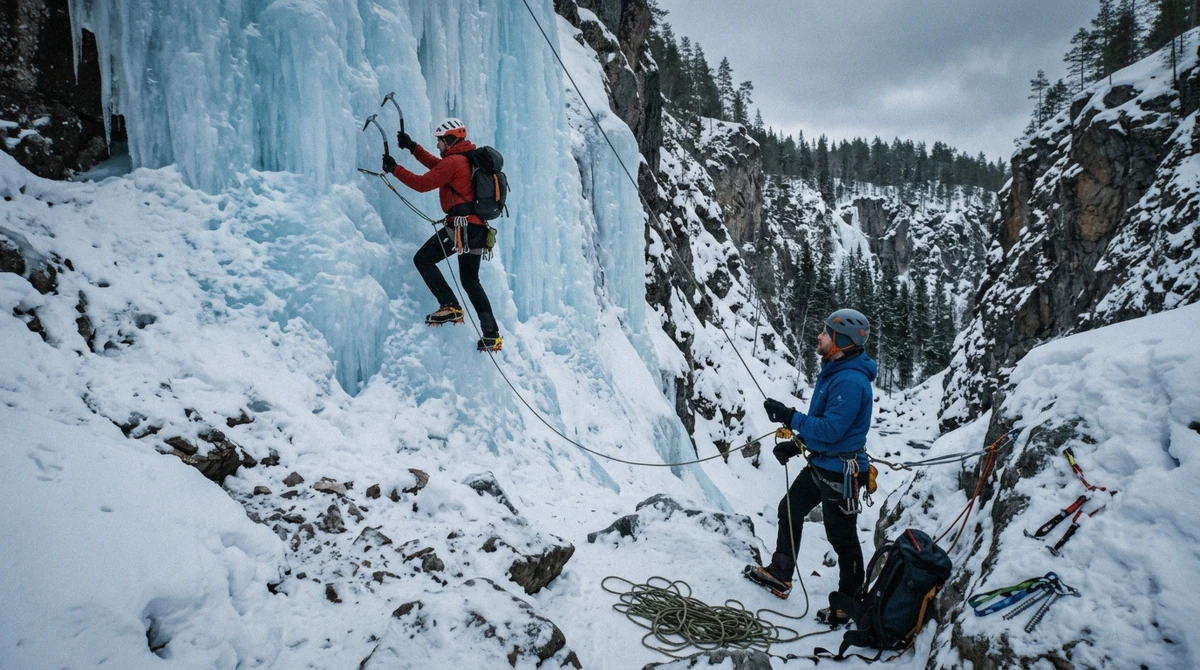
Ice climbing at Korouoma is the reason Metsahallitus calls this the largest and best-known ice-climbing site in Finland, and on a bright February weekend there will be ropes on Mammutti. The canyon holds six named icefalls on the day-hike loop alone, from thin finger-like curtains to a sixty-metre wall with a flow strong enough to set in October some years. This is what climbers come for, what the walls are like, how the season runs, and why hikers on the same trail are asked to keep their distance from the base.
Quick answer Which walls take routes, when they form, and where a hiker fits in
Korouoma is Finland's largest and best-known ice-climbing venue. Mammutti is the popular wall, forty metres wide with routes across a range of difficulty; Ruskea virta is the serious one, with middle routes rising to about sixty metres and a flow strong enough to be climbable at the turn of October and November in an early frost. None of the guided hikes on this site includes climbing, and Metsahallitus asks everyone else to stay out from under the ice.
Key takeaways
- Mammutti: 35 to 50 m high, 40 m wide, spring-fed and blue, the most-climbed wall here
- Ruskea virta: the highest in the canyon, middle routes around 60 m
- The season runs from late October in a good year to the turn of May and June
- No hiking tour here sells climbing. What the guided Korouoma hikes include
- Watch from the trail: ice blocks and stones come off the walls
The Walls, and What Each One Offers
Mammutti, the working wall
Mammuttiputous is where the ropes usually are. Metsahallitus gives it as 35 to 50 metres high and about 40 metres wide, at an angle between 50 and 90 degrees, and describes it as one of the most popular climbing spots at Korouoma, offering several routes of varying difficulty across that width.
The ice is fed by a brook rising on the slopes of Yli-Voho Hill, and most of that water comes from a spring. Spring water is clear rather than peat-stained, which is why Mammutti freezes blue while its neighbour freezes orange-brown. For a climber that means denser, more consistent ice than a fall fed by surface run-off.
Ruskea virta, the big one
At Piippukallio, Ruskea virta is Korouoma's largest and highest icefall, 35 to 60 metres with routes in the middle section rising to about 60 metres, and the reserve says outright that it poses a challenge even for more experienced climbers. Its water flow is strong all through the winter, which is why it can be climbable at the turn of October and November when the frost sets early, and why its last ice usually survives to the turn of May and June.
The brown colour that gives it its name comes from iron-rich water. Against fresh snow it is the most photographed wall in the canyon, and it is also the one where a hiker is most likely to see a party at work.
The conditional walls
Three of the six form unreliably, which matters to a climber planning a trip. Tuulen tie hangs in thin finger-like columns across 80 to 100 metres of cliff and is not climbable every winter. Jaska Jokunen carries water mainly in late autumn, so the ice is thin and flaky most years, though in some winters its middle section hollows into an ice cave that has been used for an adventurous overnight. Onnekas forms infrequently, and sits about 100 metres upstream of Mammutti along the Korojoki.
Revontuliputous, the first fall walking clockwise, is in the same category: about forty metres of wall, five to ten metres wide, and usually thin.
Why the Ice Is Here at All
A fracture, not a valley
Korouoma is not a river gorge carved out over time. It is a fracture zone in the bedrock, formed hundreds of millions of years ago when the rock itself broke along a line, and the river found the crack afterwards. That origin is why the walls are so abrupt: thirty kilometres of near-vertical rock face rather than the graded slopes of an eroded valley.
Vertical rock is a precondition for icefalls. Water needs somewhere to fall from before it can freeze on the way down, and Korouoma provides a hundred metres of it, repeatedly, along the same line.
Springs, seepage and colour
The other precondition is water that keeps coming through the winter, and the canyon has two kinds. Springs, which deliver clear water at a steady temperature and volume, and produce dense blue ice: Mammutti is the example. And surface seepage or bog drainage, which delivers less water, stops when the ground freezes, and carries iron and peat, producing thinner ice with a brown or orange cast: Ruskea virta takes its name and its colour from exactly that.
This is also why the walls behave so differently from one another across a season. A spring-fed fall grows steadily all winter. A seepage-fed fall is a record of last autumn's rainfall, which is why three of the six are unreliable and one of them, Onnekas, forms only in some years at all.
What that means standing there
The practical version of all this: on the same wall, in the same week, you can look at ice that is dense and blue and forty metres wide next to ice that looks like a bundle of frozen cables. They are not the same substance and they do not climb the same way.
For a hiker it is simply a good story to have in your head while you walk. For a climber it is the whole route selection. Either way the icefall inventory lists which is which, with the reserve's own measurements.
The Season, and Reading It From Home
When each wall is likely to be in
Formation depends on autumn rainfall and how early the frost holds. The pattern below is what the reserve's own descriptions imply, and any given winter will differ.
| Wall | Earliest | Reliable window | Last ice |
|---|---|---|---|
| Ruskea virta | Turn of October and November in an early frost | December to April | Turn of May and June |
| Mammutti | November | December to April | Late spring |
| Jaska Jokunen | December | January to March, thin most years | April |
| Tuulen tie | December | Not climbable every winter | April |
| Onnekas | Forms only some years | January to March | April |
| Revontuliputous | November | Thin and flaky most years | April |
What the hiking season tells you
The commercial hiking season is a decent proxy. Operators run from November to April, and the guided listings cluster their departures in the months when the walls are standing. If the tours are selling in volume, the ice is in.
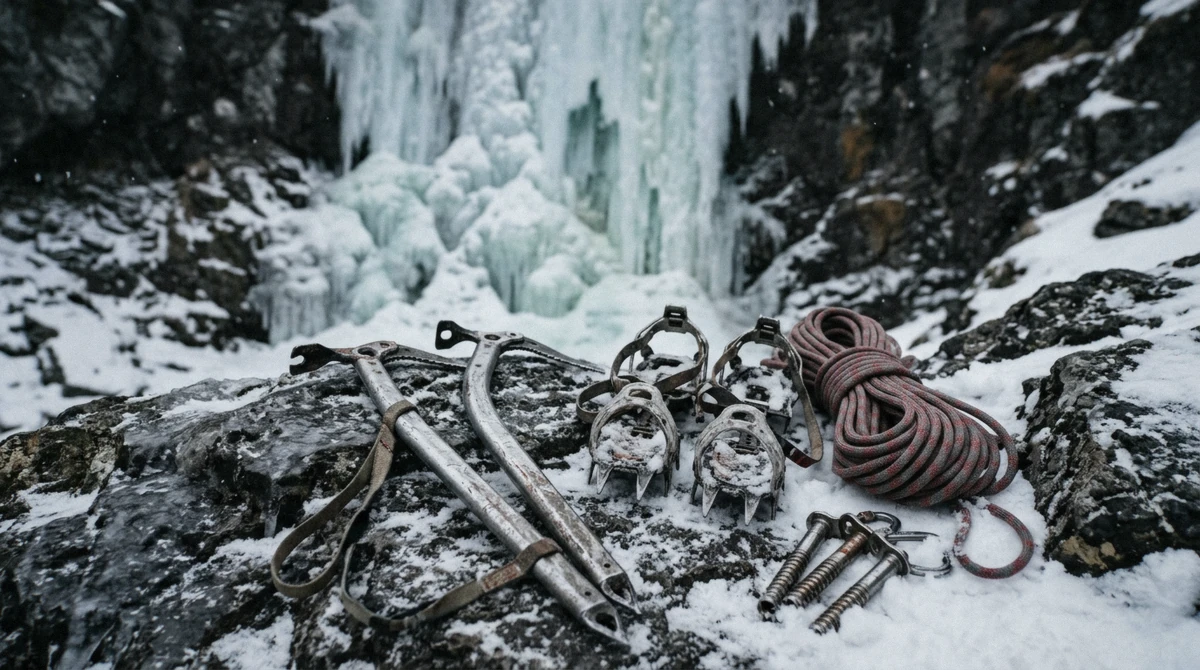
The trail itself is the other constraint. The Koronjaa loop is graded Hard and gets no winter maintenance, so approaching with a rack, a rope and axes over a roped descent is a different proposition from walking it empty-handed. Climbers carry their gear down the same pitch the tour groups shuffle down.
How Climbing Here Is Arranged
Not on any of these listings
None of the departures compared on this site includes climbing. They are hiking tours: you walk the loop, you look at the ice, and if there is a party on Mammutti you watch them from the trail. That is worth saying plainly, because more than one general guide to Korouoma implies the two are interchangeable.
Guided introductory climbs exist and are arranged separately with a climbing guide, usually as a private booking rather than a scheduled departure. Some Rovaniemi operators will coordinate one on request. If climbing is the object of the trip, that arrangement comes first and the hiking day is the alternative for the rest of the party.
If you climb already
Korouoma is a walk-in venue: park at Saukkovaara, descend the trail, and the walls are strung along the canyon floor within a couple of kilometres. Entry is free and there is no permit, though the Saukkovaara car park is charged from 1 September 2026, and the reserve's visitor rules are the ordinary ones: camp only beside marked rest and campfire sites, fires only at designated pits and never under a wildfire warning, carry everything out, dogs on a leash.
What is not there: firewood at the lean-tos on the long trail, which Metsahallitus stopped supplying on 1 June 2025, a water point, bins, or reliable mobile coverage in the canyon. The nearest town of any size is Posio, and Rovaniemi is ninety minutes away.
Hikers and Climbers, Same Canyon
The rule that covers both
Metsahallitus asks visitors not to climb or stand under the frozen waterfalls, because ice blocks and stones detach and fall, and adds that this is also why ice climbers should be watched from a distance.
The risk is not theoretical and it is not only about the climbers above you: an unclimbed wall in a thaw sheds material of its own. Guided groups keep back from the base, and the viewpoints along the trail are positioned accordingly.
| Hikers | Climbers | |
|---|---|---|
| Where you stand | At the marked viewpoints, back from the base | At the foot of the route, roped and helmeted |
| Grips | Cleats over winter boots | Crampons, on a rigid sole |
| Under the fall | Never | Only as the route requires, helmeted |
| If a party is on the ice | Watch from the trail, do not walk beneath | Manage your own fall line |
Why watching is worth the wait
A photograph of an icefall gives you no scale at all. A climber halfway up Mammutti gives you forty metres of it instantly, and it is the moment most people on a hiking day realise what they are looking at.
The listings that schedule about four hours in the canyon are the ones with slack to stop and watch; the six-hour day walks on. If ice climbers are part of what you came to see, that is another argument for the longer stay, and the tour comparison shows which is which.
Ice Climbing at Korouoma: Common Questions
Can a beginner ice climb at Korouoma?
With a climbing guide, yes: Mammutti carries routes across a range of difficulty on forty metres of width, which is what makes it the teaching wall here. It is not something to attempt unguided on a first visit, and none of the hiking tours on this site includes it.
How high are the climbs?
Ruskea virta's middle-section routes rise to about sixty metres and it is the highest ice in the canyon. Mammutti runs 35 to 50 metres, Jaska Jokunen and Onnekas about fifty, and Revontuliputous and Tuulen tie about forty.
When does the ice-climbing season start?
Ruskea virta can be climbable at the turn of October and November when the frost sets early, because its flow is strong all winter. The rest of the canyon needs longer, and the reliable window is December through April.
Do I need a permit to climb there?
No. Korouoma is a Metsahallitus nature reserve with free access, no gate and no ticket. The ordinary reserve rules apply: fires only at designated sites, camping only beside marked rest areas, and everything you bring goes out with you.
Is it safe to walk under the frozen waterfalls for a photograph?
No, and the reserve says so directly. Ice blocks and stones detach from the walls, which is why viewpoints are set back and why climbers are watched from a distance rather than from the base.
Can I combine a climb with a hiking tour on the same day?
Not on these listings. They are separate products with separate guides, and the hiking departures run to a fixed schedule with a group of eight. Plan a climbing day, and put the hiking day on either side of it.